Proof Architecture
The formalization studies one object, the delay map
delayEmbedding in Lean, at three levels of structure: finite state spaces, where
reconstruction is a combinatorial question; ordinal codes, which keep only the order of the
window; and compact manifolds, where the classical question is whether \(\Phi_{2d+1}\) is an
embedding. A self-contained account of Sard's theorem supports the smooth part.
Dependency diagram
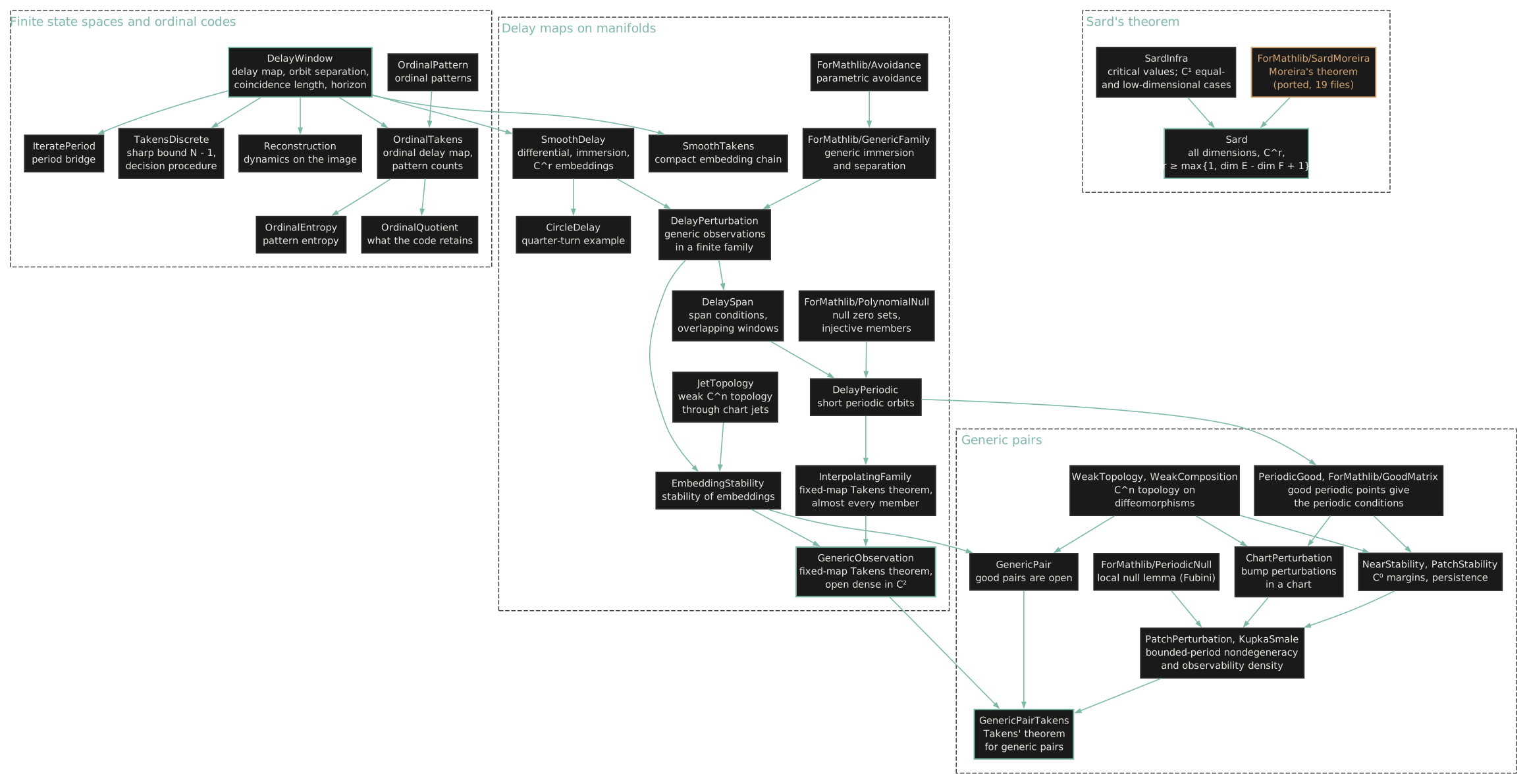
Arrows are imports. DelayWindow defines the delay map once, for arbitrary types, and every
smooth statement is about that same map (smoothDelayMap_eq_delayEmbedding). The
general-purpose layer TakensFormal/ForMathlib/ imports only Mathlib. The diagnostic
modules Verify (axiom records) and Examples (worked checks) are built by CI but not
imported by the library.
Finite state spaces
On a finite state space the delay map is injective exactly when the observation separates
orbits (delayEmbedding_injective_iff_separatesOrbits). The coincidence length of two
states, the first time their observations differ, determines the least window that
separates all orbits, the separating horizon. When some window separates, the horizon on
\(N \ge 1\) states is at most \(N-1\), and the countdown chain shows that this bound is
attained. A decision procedure
returns either the exact horizon or a pair of states that no window distinguishes, and is
proved sound and complete. When the delay map is injective, the dynamics transported to its
image is an explicit shift, conjugate to the original map. See
Delay Embedding and Coincidence Length.
Ordinal codes
An ordinal code replaces the window by the permutation that sorts it. It is unchanged by strictly increasing transformations of the observation and is relabeled by the index reversal under strictly decreasing ones. The number of observed patterns, and the entropy of their empirical distribution, are bounded by \(d!\), the orbit length and the minimal period. The code cannot be injective on more than \(k!\) states, so exact reconstruction is a question about the delay map, not the code; what the code retains is described by its quotient. See Ordinal Compression.
Compact manifolds
For \(C^r\) dynamics and observation, the delay map is \(C^r\), its differential is given by the delayed covectors \(Dh_{T^i x} \circ D(T^i)_x\), and on a compact manifold an injective immersion is a \(C^r\) embedding. The genericity argument is organized in layers:
- Avoidance. For a finite-dimensional family of maps with surjective derivative in the
parameter, almost every parameter avoids a set of lower dimension
(
ae_forall_ne_of_hasStrictFDerivAt), because the bad parameters are the projection of a level set covered by Lipschitz images of lower-dimensional pieces. - Generic families. Applied to affine families \(\Psi_0 + \sum_i a_i \Psi_i\), this gives generic immersion when \(2\dim X \le \dim Y\) and generic separation when \(\dim X_1 + \dim X_2 < \dim Y\), under span conditions on the \(\Psi_i\).
- Delay maps. In extended charts (countably many, by second countability) the delay
map of \(h + \sum_i a_i \varphi_i\) is such an affine family, so the span conditions give
a \(C^2\) embedding for almost every \(a\)
(
ae_isContMDiffEmbedding_delayEmbedding_perturb). - Span conditions. If \(T\) is injective with injective differentials and has no periodic points of period at most \(4d\), the span conditions follow from interpolation properties of the family. Overlapping windows \(y = T^m x\) reduce to the triangular system \(v_j - v_{j+m} = c_j\), solved explicitly.
- An interpolating family. A Whitney embedding \(e : M \to \mathbb{R}^n\) and powers of finitely many moment functionals \(q \mapsto \sum_r t^r q_r\) interpolate values, derivatives and covectors at any bounded number of points (Lagrange interpolation).
- Short periodic orbits. At a point of period \(p \le 2d\) the delayed covectors are \(\omega \circ A^j\) for \(A = D(T^p)\) after a Krylov tiling of the indices, so an observable \(A\) gives an immersion for one coefficient vector, hence for almost every one (nonzero polynomials vanish on null sets). Pairs of periodic points are countably many and separated one at a time.
- The \(C^2\) topology. The weak \(C^n\) topology on \(C^n\) maps is defined through
chart derivatives on compact windows (
JetTopology). Injective immersions of a compact manifold are stable under \(C^1\)-small perturbations, and the delay map depends continuously on the observation (EmbeddingStability); a family perturbation tends to the observation as the coefficients tend to zero. The \(C^n\) topology on diffeomorphisms uses charts on both source and target (WeakTopology); closeness is preserved by composition and iteration (WeakComposition), so the delay map is stable under perturbations of the pair and the good pairs are open (GenericPair). - Bounded-period nondegeneracy and observability density (Kupka--Smale-type). By
induction on the period, diffeomorphisms whose periodic
points of period at most \(4d\) are nondegenerate with observable differentials are dense
(
KupkaSmale): old periodic orbits are protected by supporting perturbations away from them (NearStability), and new ones are made good in chart patches by bump perturbations (ChartPerturbation,PatchPerturbation), almost every perturbation being good by a Fubini argument (PeriodicNull) and goodness persisting (PatchStability).
Together these prove Takens' theorem for a fixed map satisfying the periodic-point
conditions: almost every member of one finite family is good
(exists_family_forall_ae_isContMDiffEmbedding_delayEmbedding_of_periodic), and the good
observations are open and dense in the \(C^2\) topology
(isOpen_and_dense_setOf_isContMDiffEmbedding_delayEmbedding). With this density
they give Takens' theorem for generic pairs: the good pairs are open and dense in
\(\mathrm{Diff}^2(M) \times C^2(M, \mathbb{R})\)
(isOpen_and_dense_setOf_isContMDiffEmbedding_delayEmbedding_pair). See
Smooth Embedding.
Sard's theorem
SardInfra defines critical values and proves the equidimensional case (Jacobian area
formula) and the low-dimensional case (Hausdorff dimension) for \(C^1\) maps. The general
case, \(C^r\) with \(r \ge \max\{1, \dim E - \dim F + 1\}\), follows from Moreira's theorem, whose Lean
proof by Yury Kudryashov is ported in TakensFormal/ForMathlib/SardMoreira/. See
Sard's Theorem. The genericity argument above does not use
Sard's theorem: the avoidance lemma needs only the implicit function theorem and a
dimension count.
References
- [Takens1981] F. Takens, Detecting strange attractors in turbulence, Lecture Notes in Mathematics 898 (1981), 366--381.
- [SauerYorkeCasdagli1991] T. Sauer, J. A. Yorke, M. Casdagli, Embedology, J. Stat. Phys. 65 (1991), 579--616.
- [Moreira2001] C. G. T. de A. Moreira, Hausdorff measures and the Morse-Sard theorem, Publ. Mat. 45 (2001), 149--162.